
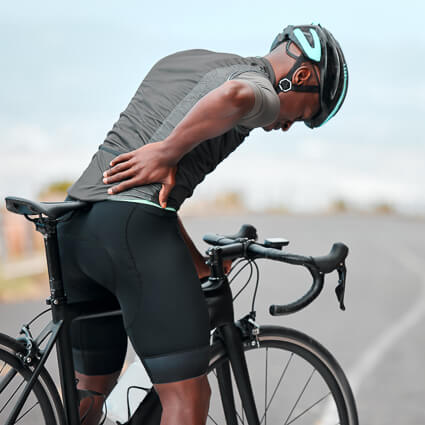
Mountain biking asks a lot of your body. You’re leaning forward, gripping the bars, climbing, and absorbing bump after bump for miles at a stretch, whether you’re flowing through Phil’s Trail, grinding up Tiddlywinks, or looping Wanoga on a Saturday morning.
Your legs get most of the credit, but your lower back is doing quiet, constant work the whole time (usually right around the point on a climb where you’d rather be thinking about anything else). Ask those stabilizing muscles to do that for long enough and they get tired. Tired muscles get stiff. Stiff muscles start rebelling.
It’s Often Your Hips, Not Your Back
Here’s the part that surprises a lot of riders: the back usually isn’t where the problem starts. Hours in the saddle shorten the hip flexors and tighten everything around the pelvis. Once those muscles lose their give, your lower back ends up compensating on every pedal stroke and every climb, which is a job it was never built to do alone.
“Your back is working overtime because your hips aren’t doing their job. It’s one of the most common patterns I see in active adults throughout Bend,” says Dr. Michael Tobey.
Core fatigue plays a role too. Plenty of riders have strong legs and great cardio but a core that gives out well before the legs do. Once that happens, posture starts to slip. Shoulders round forward, the spine curls, and the lumbar region picks up the slack, mile after mile.
What’s Actually Causing It
There’s rarely just one culprit. Sometimes it’s restricted movement in the spine. Other times it’s an irritated SI joint, a muscle imbalance between one side of the body and the other, or years of accumulated wear and tear finally catching up on a long descent. Every rider carries their own combination of these factors, which is part of why two people can ride the exact same trail and walk away with completely different bodies at the end of the day.
A Few Habits That Go a Long Way
Most of this is preventable with some fairly simple adjustments:
- Warm up for 5 to 10 minutes before you hit the trailhead
- Stretch the hip flexors, glutes, and hamstrings after every ride
- Work on core strength two or three times a week
- Change riding positions occasionally on longer climbs, rather than locking into one posture
- Check your bike fit. A saddle set too high or bars set too low puts real strain on your lower back
- Stay hydrated, since fatigued muscles tighten up faster
Small habits, repeated over a season of riding, add up to a noticeably happier back.
When It’s Worth Getting Checked
Soreness after a big day on Tyler’s Traverse or Maston is normal. Pain that hangs around for days, shows up after every single ride, shoots into your hip or leg, or brings numbness or tingling along with it is a different story. That’s worth having someone take a look at before it becomes a habit your body settles into.
Chiropractic care can help restore movement in the spine, ease tight hips, and get your core and back working as a team again instead of fighting each other. A thorough exam helps sort out what’s actually driving the pain, whether that’s the spine, the hips, an old imbalance, or some combination of all three, rather than just chasing the symptom.
Paired with a little mobility work and a better bike fit, most riders find they can put in more trail time with a lot less to complain about afterward.
Dr. Tobey’s Takeaway
Mountain biking should strengthen your body, not sideline it. A little attention to mobility, core strength, recovery, and body mechanics goes a long way toward keeping you riding stronger and longer, with a lot less back pain along the way. The best rides, after all, are the ones you’re ready to do again tomorrow.
Bend Bonus Tip: Before a longer ride out of the Wanoga Sno-Park trailhead, or a day trip over to Peterson Ridge, spend five minutes warming up with a brisk walk and a few hip-opening stretches. Your lower back will thank you before you even hit the first climb.